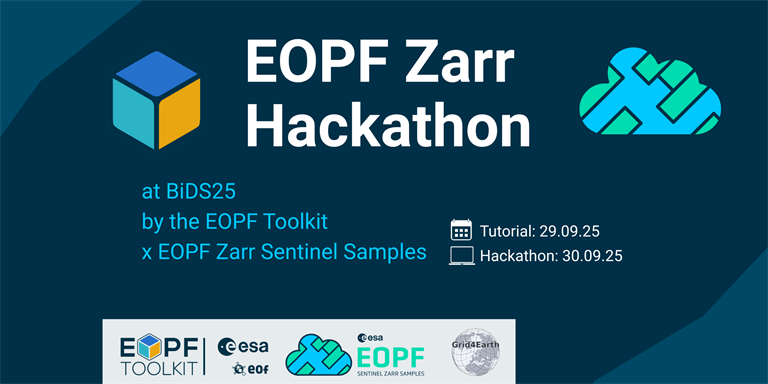
About the event
As part of this year’s Big Data from Space (BiDS25) conference, the EOPF Zarr Hackathon offered a unique opportunity for the Earth Observation community to come together and explore cutting-edge, cloud-native technologies aimed at transforming how we access and process data from the Copernicus Sentinel missions.
This webinar was a joint effort between our service and the EOPF toolkit team, reflecting a shared commitment to advancing open, cloud-native approaches to Earth Observation.
Designed for participants of all levels, from newcomers to advanced users, the hackathon focused on collaborative problem-solving and hands-on experimentation with the Earth Observation Processing Framework (EOPF) and its growing suite of tools and data services.
A Practical Approach to Innovation
At the core of the hackathon was a commitment to addressing real-world challenges using scalable, cloud-native approaches. Participants engaged with a range of advanced formats and tools, including Zarr, STAC, Dask, and Julia. The aim was to explore how these technologies can support more efficient, open, and flexible EO data workflows.
The event covered a number of technical themes, such as optimising chunking strategies, applying the Discrete Global Grid System (DGGS) —in particular, HEALPix—, testing Parquet for metadata storage, and contributing to discussions on GeoZarr and CF-conventions. These sessions were supported by open datasets drawn from the EOPF Zarr Samples Service, including Sentinel-1 and Sentinel-2 examples.
Participants were also encouraged to bring their own data and use cases, helping to ensure that the hackathon remained grounded in practical applications with direct user relevance.
Building Knowledge Together
To ensure broad accessibility, a half-day tutorial took place the day before the hackathon. This session introduced participants to the EOPF ecosystem and the tools required to take part effectively, including working with Zarr-formatted EO data in Python or Julia environments.
The tutorial was particularly suited for those who may be new to EOPF or cloud-native EO processing. By the end of the day, participants had a solid foundation in both the concepts and the tools, enabling them to contribute meaningfully to the collaborative sessions that followed.
Shaping the Future of EO Data
This hackathon was more than a technical exercise. It was a space for open exchange, user-driven experimentation, and community feedback. Participants had the opportunity to influence the development of the EOPF Zarr Samples Service, GRID4EARTH initiative, helping shape tools that are still evolving in response to user needs.
The event also formed part of a broader effort to support the transition toward cloud-native EO data services, aligned with European and international initiatives promoting interoperability, open standards, and scalable data access.
How to Join
The EOPF Zarr Hackathon took place as a side event at BiDS25 and was open to all registered conference participants. It included two key components: a full-day tutorial session and a full-day hackathon.
Location: BiDS25 side event, Riga, Latvia
Dates: 29.09.25 Tutorial | 30.09.25 Hackathon
Register here
Programme: BiDS25 Satellite Events
Whether you were an expert in EO data processing or just beginning to explore the potential of cloud-native technologies, we invited you to join us. This was a chance to connect with peers, contribute to emerging solutions, and help shape the future of Earth Observation.
For more information, please visit the BiDS25 page.