About the event
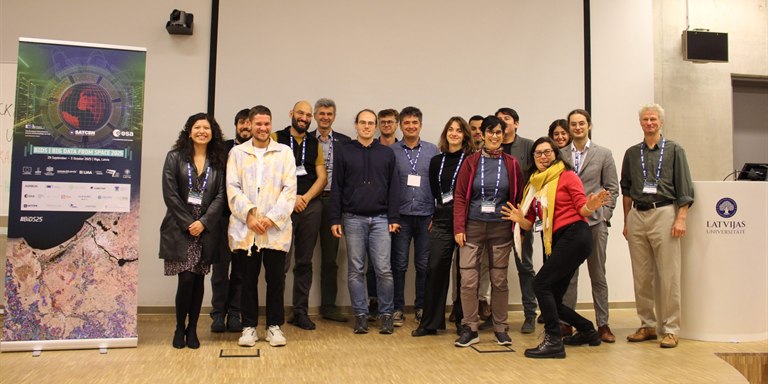
Co-organised with the EOPF Toolkit, two dedicated sessions at BiDS25 focused on advancing cloud-native approaches for Earth observation. Held on 29 and 30 September 2025 in Riga, these sessions introduced participants to new tools and methods for scalable, user-friendly analysis of the new EOPF Zarr Sentinel data.
The tutorial was led by Gisela Romero Candadeno (thriveGEO) and Konstantin Ntokas (Brockmann Consult), and the hackathon by Anne Fouilloux (Simula), with contributions from members of the EOPF and broader EO community. The event was announced in EOPF Zarr Hackathon: driving innovation in cloud-native Earth observation.
Tutorial: EOPF Sample Service – Getting Started with Zarr
The first session provided an introduction to the EOPF ecosystem and its use of Zarr and STAC to enable efficient access to large-scale satellite data.
The tutorial covered the principles of data analysis workflows and demonstrated how Zarr supports cloud-native data storage. Participants learned how to browse the EOPF STAC catalog via its web interface and programmatically through pystac-client, gaining practical experience in filtering and accessing Sentinel data collections.
It also presented new plugins developed under the EOPF Sample Service, which simplify access and integration of EO datasets across platforms:
- xarray EOPF backend
- xcube EOPF data store
- GDAL EOPF reader
- Julia EOPF reader
A guided exercise on wildfire monitoring in Sardinia illustrated how Sentinel data can be combined and analysed using Python libraries such as xarray and Dask. The session concluded with a discussion on how Zarr and STAC together contribute to reproducibility, interoperability and open science within the BiDS community.
Hackathon
The following day, the EOPF Hackathon brought these ideas into practice. Under the theme “Transforming how we access and process Copernicus Sentinel data using cloud-native technologies”, participants worked collaboratively to develop prototype workflows and test new approaches using the EOPF Sentinel Zarr Samples Service. Teams explored applications of DGGS/HEALPix for spatial aggregation, tested performance optimisation techniques, and examined metadata alignment across GeoZarr, CF conventions and STAC.
Projects that emerged from the event included:
- Analyses of spectral diversity and land-use classification using Sentinel-2 data
- Visualisation of NDVI products with TiTiler and xcube-viewer
- Experiments with DGGS-based processing for global data representation
Results and notebooks were shared publicly in the EOPF-Zarr-BiDS25 repository, ensuring that all outputs remain accessible to the wider community.
Community feedback
Participants were also encouraged to provide structured feedback on the EOPF Sample Service and DGGS integration. The collected input will form an open document summarising user experience and community recommendations.
Together, the tutorial and hackathon demonstrated how open standards and collaboration can make Earth observation data more accessible and efficient to use. By combining Zarr’s scalability with DGGS’s global grid architecture, the EOPF community continues to support the development of transparent, interoperable and cloud-ready analysis workflows.